
For Adivasis, MGNREGA’s Undoing Will Have Devastating Consequences
The new framework rests on conditions that do not exist in most tribal regions, and this will lead to systematic exclusion—quiet, but deeply consequential
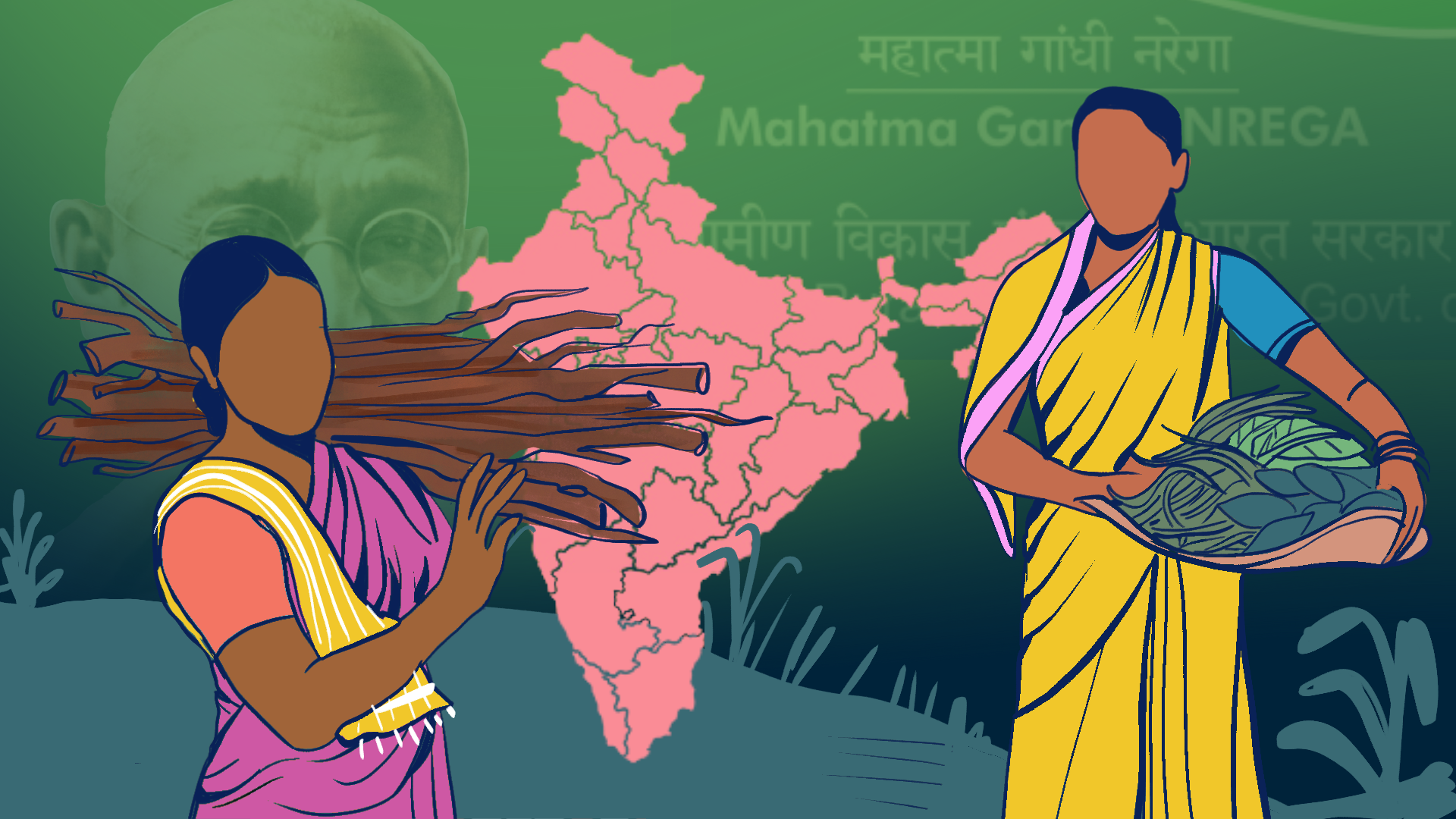
The Viksit Bharat–Guarantee for Rozgar and Ajeevika Mission (Gramin) Act, 2025 (VB G RAM G) is being presented as a modern and efficient replacement for the Mahatma Gandhi National Rural Employment Guarantee Act (MGNREGA). The new framework promises 125 days of employment, predictable funding through normative allocations, improved asset creation, and closer alignment with national development priorities.
Yet an analysis of these design choices from the perspective of Adivasi regions shows that there are causes for serious concerns. The problem is not merely one of implementation capacity, but of assumptions that do not hold in tribal contexts. This matters because Scheduled Tribes are not marginal participants in rural employment.
This analysis draws on over two decades of field engagement with Adivasi communities, including sustained research and action work across Andhra Pradesh’s Integrated Tribal Development Agency (ITDA) regions. Though the data and analysis are drawn primarily from Andhra Pradesh, the institutional and design features examined in this analysis are not state specific.
According to reworked population estimates based on the 2011 Census and prepared by the Tribal Welfare Department after bifurcation of erstwhile Andhra Pradesh, in 2024–25 Adivasis constituted just 5.53% of Andhra Pradesh’s population. Yet they accounted for around 9.8% of active workers in the state, defined as those who worked for at least one day in the last three years. Their share of MGNREGA employment was even higher at 12.5%, more than double their population share, as per NREGA MIS data.
Estimated ‘average annual earnings’ from MGNREGA among Scheduled Tribe households during the year stood at around Rs 13,190, indicating how even modest employment plays a critical role in sustaining subsistence livelihoods. Thin income buffers and high exposure to seasonal shocks mean that the withdrawal of a demand-driven employment guarantee is likely to have far more severe consequences for regions with high Adivasi populations, a risk that can reasonably be anticipated across tribal regions in multiple states as similar employment architectures are adopted.
The quantitative estimates cited here are derived from the analysis of publicly available administrative data by LibTech India, a team of engineers, social workers and social scientists interested in improving public service delivery in India. This includes the MGNREGA Management Information System, covering the period from 2019–20 to 2024–25. The qualitative insights are informed by the author’s two-decade long field engagement with Adivasi communities across multiple districts and all six Integrated Tribal Development Agency (ITDA) regions of Andhra Pradesh.
Legal Guarantee To Conditional Promise
Under MGNREGA, the right to work was legally enforceable and demand-driven: the State was obligated to provide employment to any rural household that demanded it or pay an unemployment allowance. This design was particularly critical in Adivasi regions, where livelihoods are insecure, markets are thin, and state capacity is uneven.
In Scheduled Areas (areas with a majority tribal populations), this demand-driven architecture also aligned with the constitutional intent of the Panchayats (Extension to Scheduled Areas) Act (PESA), which recognises the Gram Sabha as central to local planning, resource use, and livelihood decisions. This enabled Gram Sabhas in Adivasi regions to articulate seasonal employment needs without prior notification or eligibility filtering, unlike in other rural regions with more diversified livelihood options.
The VB–G RAM G Act’s shift towards centrally notified geographies and capped allocations reduces the role of local institutions envisaged under PESA and re-centralises decisions that were meant to rest with Adivasi communities.
The VB–G RAM G Act speaks of “guaranteed” employment, but its Section 5 limits this guarantee to rural areas notified by the Union Government and within centrally determined normative allocations. Employment is no longer triggered by demand, nor backed by an open-ended fiscal obligation. Once allocations are exhausted, the law provides no mechanism through which households can enforce the provision of work.
In effect, the Act replaces a legal right to work with a conditional promise of employment, dependent on geography, budget ceilings, and administrative discretion. For communities whose survival depends on predictable access to wage work, this distinction is not semantic—it is fundamental.
The Scale of What Is at Stake
In Andhra Pradesh alone, across about 41 tribal blocks, nearly 4.8 lakh registered tribal workers accessed MGNREGA in 2024–25. Across the state’s six ITDA regions, Scheduled Tribe households earned an estimated Rs 732 crore in MGNREGA wages during the year. Average employment per household in tribal areas was 73 days, significantly higher than the state average of 51.6 days.
This flow of income supported consumption, reduced distress migration, and sustained fragile rural economies in some of the state’s most ecologically and administratively marginal regions. Any redesign of rural employment that weakens coverage, certainty, or enforceability will therefore not affect a small subset of workers. It will disrupt livelihoods at scale across Andhra Pradesh’s tribal belt, especially during summer and lean months when alternative employment is scarce.
Risk of Systemic Exclusion
Section 5 of the VB–G RAM G Act empowers the Union Government to notify the rural areas where the scheme will operate. The criteria for selecting these areas have not been clarified, but if coverage is restricted through geography-based targeting—such as “backward” or “aspirational” units—exclusions are a likely possibility. In Andhra Pradesh, for instance, aspirational districts and block lists cover only a small subset of tribal geographies, leaving out districts and blocks with substantial Adivasi populations and rendering numerically smaller communities invisible behind district-level averages.
An alternative would be to target Scheduled Tribes directly but that would convert employment into a regime dependent on document-based proof of identity. But field experience in Andhra Pradesh shows that many Adivasi households lack caste certificates, have inaccurate Aadhaar records, or do not possess updated land documents, and some communities continue to be administratively misclassified in official records. In some cases, the absence of Aadhaar itself reflects long-standing gaps in birth registration, which disproportionately affect older Adivasi persons.
For example, in Prakasam district, field research found that large numbers of Chenchu tribe households were recorded as non-tribals in MGNREGA rolls; under a tribal-only scheme, such households would be excluded by default. What appears administratively neat on paper thus risks producing systematic exclusion in practice.
As stated before, the new Act replaces demand-driven financing with normative allocations, promising predictability and fiscal discipline. Experience from tribal regions suggests that predictability often comes at the cost of responsiveness. Even under MGNREGA, where employment was legally demand-driven, districts operated under advance labour ceilings because annual labour budgets were pre-approved and tightly restricted by the Union government, particularly in recent years. As a result, there was little scope to respond to additional demand once these limits were reached.
In one tribal district of Andhra Pradesh, officials acknowledged to the author that employment was likely to fall compared to the previous year because the district’s labour budget had already been exhausted. They also indicated that the likelihood of any increase was low, as the state-level labour quota had been fully utilised. Without additional allocation from the state, there was no scope to respond despite clear demand.
Normative funding institutionalises budget exhaustion as an endpoint, converting district administrations from guarantors of work into managers of scarcity.
Technology As Precondition
Under MGNREGA, technology was introduced largely through executive guidelines yet its impact on access was significant. In Andhra Pradesh’s 41 tribal blocks, when Aadhaar-based payment systems were made mandatory, around 3.25 lakh workers were deleted from the rolls in 2022–23. More recently, when e-KYC became compulsory, nearly 3,000 workers were removed in just four weeks in a single district.
Under the VB–G RAM G Act, technology is no longer an administrative tool but a statutory precondition for access to work and wages, mandating biometric attendance, digital muster rolls, biometric-authenticated payments, and real-time MIS-based monitoring. While investments in digital infrastructure may improve connectivity, deeper constraints persist: literacy levels in Adivasi regions are low, and digital literacy even lower. Embedding technology so centrally in law risks converting administrative fragility into legal exclusion.
The Trouble With ‘Peak Season’
The proposal to suspend employment for 60 days during the agricultural peak season further compounds this shift. The assumption that farm work will absorb rural labour during these months does not hold in tribal regions. Agriculture in Adivasi areas is largely subsistence-oriented, rain-fed, and limited to a few months a year. Research from Andhra Pradesh’s tribal regions shows that MGNREGS was most critical during summer and lean months, when agriculture and forest-based livelihoods offer little income.
Even decentralising the decision to the district level does not resolve the problem. Tribal districts are internally heterogeneous. In Alluri Sitharama Raju district of Andhra Pradesh, for instance, hill blocks under the Paderu ITDA follow a cropping calendar that begins earlier than the plains. A uniform district-level notification of “peak season” would arbitrarily suspend employment in areas where agricultural work has not yet begun.
Taken together, all these factors transform employment from a right that responds to distress into a tightly managed system of scarcity.
Centralised Works and the Loss of Livelihood Relevance
MGNREGA allowed local governments flexibility to prioritise works suited to fragile tribal ecologies—land development, soil and moisture conservation, and individual land-based works. The new framework shifts decisively towards centrally defined, mission-aligned asset categories aggregated into nationally comparable infrastructure stacks. By tying permissible works to centrally defined Viksit Bharat missions, the framework leaves little room for Gram Sabhas in Adivasi regions to prioritise the locally specific land and livelihood works on which tribal subsistence depends.
Tribal livelihoods, however, depend on slow, labour-intensive adaptation to local environments. Centrally prescribed works risk crowding out precisely the kinds of activities that sustained Adivasi households and responded to local ecological realities.
One of the most significant aspects of MGNREGA for tribal communities is the provision of up to 150 days of employment for Scheduled Tribe households and Forest Rights Act (FRA) households. Introduced in 2014 through Schedule I, Paragraph 4(6), it constituted an explicit statutory entitlement recognising the additional labour required for land development and livelihood security in forest regions.
Under MGNREGA, Adivasi households holding individual forest pattas were eligible for up to 150 days of employment, enabling labour-intensive land development on degraded and sloped forest lands over multiple seasons. In 2024–25 alone, more than 64,000 Adivasi households in Andhra Pradesh’s tribal regions utilised this provision to make FRA lands cultivable.
The new Act contains no explicit recognition of FRA lands or the additional labour support they require. The only reference appears in Schedule I, Clause 4(6), which states that works creating individual assets “shall be prioritised” on land owned by Scheduled Tribes and FRA beneficiaries. This prioritisation, however, is not accompanied by any enhanced or protected employment entitlement.
What disappears in this recent shift is not merely additional days of work, but a statutory recognition that forest-based livelihoods require sustained, multi-season labour support. Forest rights may continue to exist on paper, but the employment support that once made those rights viable risks being quietly withdrawn.
For Adivasi communities, MGNREGA was never only about wages. It provided certainty backed by law. Its design explicitly acknowledged weak state capacity, ecological diversity, and deep social inequality.
The new framework rests on assumptions of legible populations, uniform seasons, complete documentation, and high digital readiness. In most tribal regions, these conditions do not exist. The likely outcome is therefore not greater efficiency, but systematic exclusion—quiet, procedural, and largely invisible, yet deeply consequential.

We believe everyone deserves equal access to accurate news. Support from our readers enables us to keep our journalism open and free for everyone, all over the world.
