[Readmelater]

How MGNREGA’s Repeal Will Hit Women Farmers Harder

The dismantling of the rural livelihood scheme will impact legal guarantee of employment, fair wages and accessible work – all critical for women’s rights
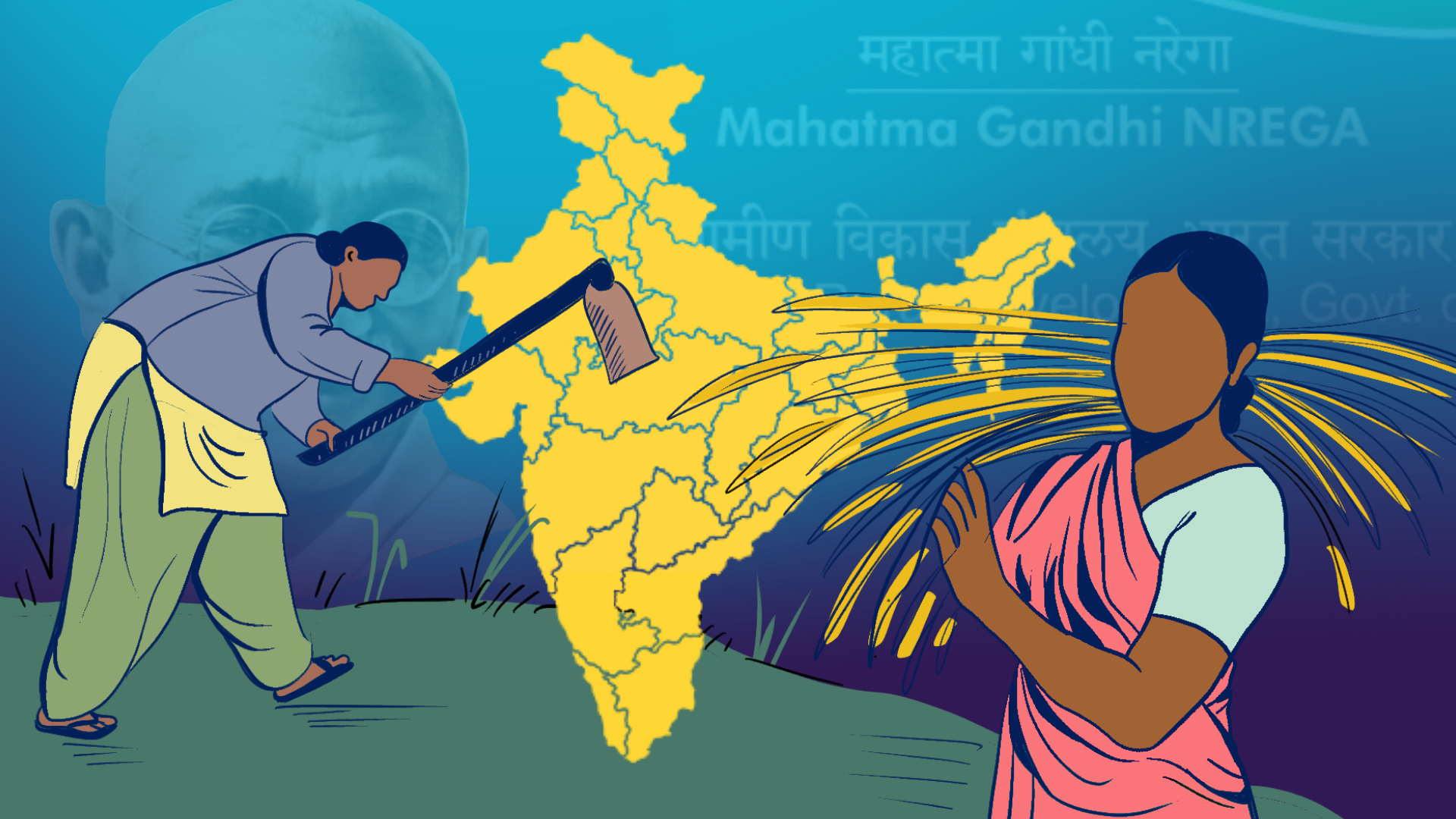
There will be a profound shift in India’s approach to rural livelihoods with the replacement of the Mahatma Gandhi National Rural Employment Guarantee Act (MGNREGA, 2005) with the Viksit Bharat–Guarantee for Rozgar and Ajeevika Mission (Gramin) Act, 2025 (VB GRAMG Act). Enacted without meaningful consultation with workers, women’s collectives, or state governments, the new law dismantles a rights-based framework that had become a lifeline for millions of rural women farmers and workers. 

We analyse the likely impact of this on women’s employment, economic security, and agency, drawing on the joint concerns of the Mahila Kisan Adhikar Manch (MAKAAM), a collective of women agricultural workers, and the Feminist Policy Collective (FPC). 

Women in Agriculture: The Invisible Backbone

Women constitute the backbone of Indian agriculture and rural economies: around 77–80%  of rural women workers are engaged in agriculture, largely as unpaid family labour, self-employed cultivators, sharecroppers, or casual agricultural labourers. Despite their central role, women’s work remains undercounted, undervalued, and underpaid (here, here and here): women in agriculture earn 20–30% less than men on average, and over 75% have little or no independent cash income.

In the context of this structural inequality, MGNREGS was not merely a wage employment programme but a critical instrument of economic citizenship because by providing a legal guarantee of up to 100 days of paid work within the village, it offered them an alternative to exploitative agricultural labour markets. It also strengthened their bargaining power, and enabled them to combine paid work with unpaid care responsibilities, as economist Dipa Sinha pointed out in a recent interview with Behanbox.

Lifeline for Rural Women

The scheme’s design was uniquely suited to the realities of poor rural women because it was demand-driven, based on self-selection, and implemented through decentralised planning. It also mandated equal wages for men and women, payment of statutory minimum wages, worksite facilities such as crèches and drinking water, and maternity-related protections. And crucially, work was provided close to home.

Its impact is evident in participation data: in 2024–25, MGNREGS generated 286.18 crore person-days of employment, supporting 5.78 crore households and providing work to 7.88 crore individuals. Women accounted for nearly 58% of total person-days, while Scheduled Castes and Scheduled Tribes together constituted 36% of beneficiaries. The Act also included special provisions for senior citizens and persons with disabilities, with 4.82 lakh differently abled workers recorded in the same year. 

During periods of agrarian distress and especially during the COVID-19 pandemic, MGNREGS functioned as a shock absorber, stabilising rural wages and preventing deeper impoverishment. For women farmers and workers facing declining real wages and precarious livelihoods, it provided a minimum floor of security.

Decentralised Planning and Women’s Agency

One of the scheme’s most transformative features was decentralised planning through Gram Sabhas and Gram Panchayats. Women were not only workers but also participants in deciding what kinds of assets would be created—water harvesting structures, land development works, soil conservation, village roads, and common property resources. These works directly supported women’s agricultural livelihoods and contributed to climate resilience.

The VBGRAMG Act significantly dilutes this decentralised architecture. Panchayats will no longer autonomously plan works based on local priorities. Instead, they will receive pre-determined lists of works and muster rolls, subject to approval by block- and district-level officials appointed by state governments. Workers may be assigned employment outside their own panchayat jurisdictions, making participation particularly difficult for women constrained by care responsibilities and mobility limitations. This centralisation undermines both local democracy and women’s agency in governance. 

From Right to Work to Budget-Capped Scheme

The scheme was a justiciable legal entitlement: any rural household demanding work was legally entitled to it, failing which the state was liable to pay unemployment allowance. The VBGRAMG Act replaces this with a normative, budget-capped allocation system. Employment availability will now depend on annual central allocations, estimated on parameters yet to be defined in the Rules.

Although the Act rhetorically promises up to 125 days of employment per household, there is no legal guarantee that this will be realised. Despite the statutory guarantee of 100 days of employment per rural household, implementation under MGNREGA has remained constrained: in recent years, only about 7% of households have been able to complete the full 100 days of work, with average employment per household hovering around 50 days, reflecting persistent budgetary and administrative limitations. Under a capped system, the effective right to work risks vanishing once funds are exhausted, disproportionately harming women who rely on predictable local employment. 

Fiscal Burden on States and Uneven Implementation

Another major departure in the new regime will be the shift in cost-sharing. Earlier, the central government bore 100% of labour costs and 75% of material costs, amounting to nearly 90% of total expenditure. The VB-GRAMG Act fundamentally alters the financing architecture of rural employment by shifting from the predominantly Central funding model under MGNREGA to a 60:40 Centre–state cost-sharing framework for most states. This change effectively transfers 40% of the financial burden to state governments, many of which are already experiencing fiscal stress and constrained borrowing capacity. Analysts and state governments have raised concerns that this restructuring may weaken states’ ability to meet employment demand, particularly during agrarian distress or economic downturns.

This is likely to result in fewer sanctioned workdays, delayed wage payments, and uneven implementation across states. Poorer states with high concentrations of women agricultural workers may be forced to ration employment, deepening regional and gender inequalities. While special category states retain a 90:10 ratio, the majority of women workers live in states that will bear the brunt of this fiscal retrenchment.

Digitalisation and Technocratic Exclusions

The new Act places heavy emphasis on digital and biometric systems for planning, attendance, payments, monitoring, and social audits. While framed as transparency measures, these systems replicate and intensify existing exclusions. Under MGNREGS, Aadhaar-based payment systems and digital attendance already led to large-scale exclusions due to poor connectivity, faulty seeding, and administrative errors.

Gram Panchayats often lack trained staff, reliable internet, or functional infrastructure to comply with complex digital requirements. A review of official e-GramSwaraj portal data shows that a significant number of Gram Panchayats have not successfully uploaded their Gram Panchayat Development Plans (GPDPs). These gaps are consistent with broader reports of uneven digital infrastructure and connectivity in rural local bodies, which hamper the effective use of e-governance tools like e-GramSwaraj. Digital barriers for older women, Dalits, Adivasis, and those in remote areas translate into loss of wages and denial of  work. Rather than addressing these failures, the VBGRAMG Act institutionalises them. 

Suspension of Work and Loss of Bargaining Power

One of the most damaging provisions of the new Act is the mandated suspension of employment for up to 60 days during peak agricultural seasons. This assumes that agricultural labour demand is sufficient and fair during these periods. In reality, agriculture already absorbs 46% of India’s workforce while contributing only 18% to Gross Value Added. Rural labour markets are characterised by underemployment, low wages, and high gender wage gaps.

For women workers—77% of whom are engaged in agriculture—the scheme had functioned as a critical bargaining lever. The suspension of guaranteed work during peak seasons forces women back into dependency on large landowners, exposes them to exploitative conditions, and pushes rural wages downward. This will further erode gender wage parity and deepen economic insecurity among marginalised women farmers and workers. 

Implications for Food, Nutrition, and Social Justice

Women farmers and workers are central to household food and nutrition security, yet they are among the most food-insecure. Undermining women’s access to an independent income threatens not only livelihoods but also nutrition, health, and education outcomes for entire households. Thus, the erosion of a universal, rights-based employment guarantee marks a retreat from constitutional commitments to social justice, equality, and dignity of labour.

The changes represent a decisive shift from a legal entitlement to a discretionary, supply-driven scheme and for rural women farmers and workers, this is not an administrative change but a fundamental loss of rights, agency, and security. 

As MAKAAM and the Feminist Policy Collective assert, a vision of ‘Viksit Bharat’ cannot be built on the erosion of women’s livelihoods and democratic rights. Women’s empowerment must begin by strengthening—not dismantling—the legal guarantee of employment, decentralised planning, fair wages, and accessible work that MGNREGA represented. 

Malini Nair (Editor)

Malini Nair is a consulting editor with Behanbox. She is a culture writer with a keen interest in gender.

Support BehanBox

We believe everyone deserves equal access to accurate news. Support from our readers enables us to keep our journalism open and free for everyone, all over the world.

Donate Now