[Readmelater]

BehanVox: The Death Of The World’s Largest Employment Guarantee Programme

This week in BehanVox: Nitish Kumar's boorish act, platform workers' exposure to air pollution, 250 years of Jane Austen, and more

Subscribe to our weekly newsletter that brings you top stories, gender news from the world, and our team’s reading recommendations.

Dear Behans! 

A truly roller coaster year almost comes to an end. There were as many highs as there were lows. But through it all, you have been such an incredible source of support and camaraderie. This is the final BehanVox for this year. Our team sends you advance warm wishes for the holiday season and a joyous 2026.

This week we look at the new law that will replace the rights-based rural employment scheme that came at the end of a vibrant phase of activism, public debate and policy framing in 2005. And an analysis of what ails the government-run One Stop Centres meant to help victims-survivors of gender violence.

Story So Far

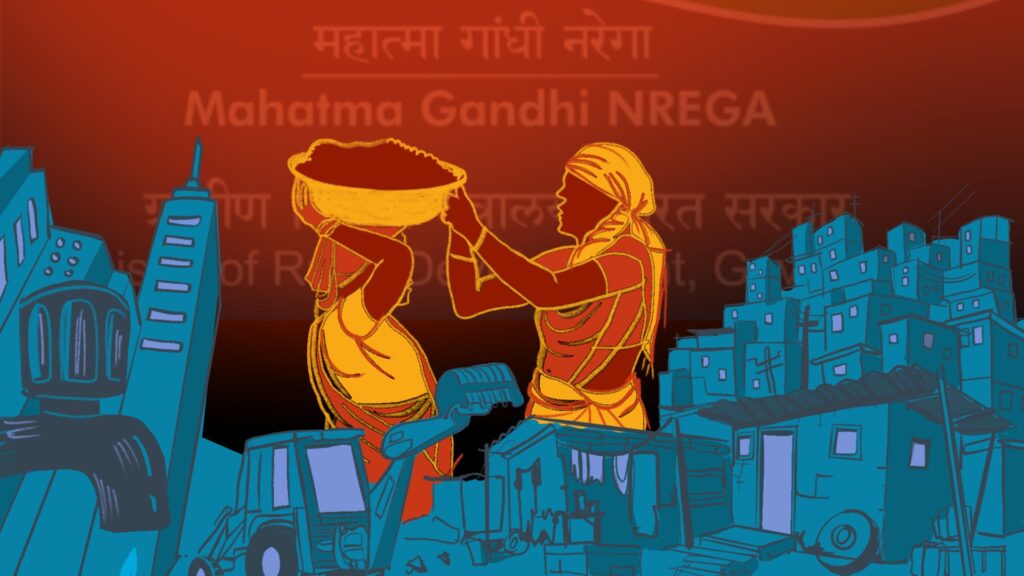
The 20-year landmark should have been an opportunity for the government to fix the glitches that have dogged its flagship rural employment guarantee scheme. We have ourselves reported extensively on these problems – on how the most marginalised of women in Maharashtra’s remote and impoverished districts do not always benefit from the scheme, forcing painful migration to distant states and how in Odisha a promise to add more days of work ran into systemic challenges, delayed payments and poor uptake.

None of this however took away from the radical shift the scheme had brought in the lives of the rural poor. It gave them the right to employment, to demand work in lean times and during crises and avoid intergenerational poverty and debt trap, it offered a way out of distress migration and most importantly gave them a semblance of bargaining power in a job market where the power balance was massively loaded against them.

The livelihood of as many as 12.16 crore workers, especially women who form 55% of its beneficiaries, stands threatened with a new Bill that stands to repeal the historic MNNREGA. On December 15, the Union Government tabled the Viksit Bharat Guarantee for Rozgar and Ajeevika Mission (Gramin), or VB–GRAMG, Bill, 2025, which was passed by the Lok Sabha on December 18 through a voice vote and by the Rajya Sabha post midnight the same day, amid Opposition protests. The Bill, which came through with no consultation with workers, unions, activists or political parties, will come into law once signed by the President. 

Among those who will be impacted by the shift is Kamla Devi from Beawar, Rajasthan, widowed some years ago and with no land or resources in her name. She has relied on work from the scheme to provide her income. “How will I survive without NREGA?” she asked at a press conference where unions came together to protest against the Bill.

The naming of the Bill is the least of its problems, though that is ideologically loaded despite protestations to the contrary. Saumya Kalia interviewed Dipa Sinha, an economist and an assistant professor at the School of Liberal Studies, Ambedkar University, Delhi, to understand the paradigm shift the Bill will bring to the implementation of the rural employment programme, its funding, and the very ethos that defined it.

The biggest problem, Dipa points out, is that it has centralised a scheme while burdening the states with financial responsibilities and curbing their freedom to spend. And more critically it has turned a right-based programme to a centrally sponsored scheme.

Dipa explains that the tendency towards overcentralisation of the scheme began to happen in different ways earlier and the bill only codifies this shift. “Under MNNREGS, the Centre makes an initial allocation at the beginning of the year, states implement the programme, and revised budgets are sought based on actual demand. Earlier this year, the government brought in a notification placing caps on how much states could ask for. The government maintained that it will “make funds available as per demand on ground”. Our argument even then was that if the Centre signals a cap in advance, states will inevitably underestimate demand during implementation because they are unsure whether funds will be released.”

Centralisation brings other problems to a project that needs to be planned locally. “Only when there is local accountability and people have ownership in the scheme can these problems of leakages and so on be addressed,” says Dipa.

Equally concerning is what this shift is going to do to the labour market and the place of the rural jobseeker. “Having this security as a demand-based right had a positive effect on the overall labour market. One was that it paved the way for a fallback wage. If there is work available at minimum wages — particularly for women, because there is no gender wage gap here, unlike in agricultural labour markets — it matters greatly. At least 55% of MGNREGS workers are women. If a woman knows that she can demand work under NREGA and earn Rs 250, which is the current average wage, her bargaining power in the labour market increases. She can refuse to work for less,” says Dipa.

This power to say ‘no’ to unfair, exploitative wages now stands threatened.

Read our interview here

And, if you are as concerned as we are, then you could show your solidarity and support to the NREGA Sangharsh Morcha who are organising countrywide protests on the new Bill which will soon become an Act.

Tanya Rana, an independent researcher studying how the welfare system reaches women in India, has been analysing for BehanBox the functioning of the government-run One Stop Centres. These hubs are meant to provide integrated support services for victim-survivors, but may be performing sub-optimally because they are unable to use their own administrative data to inform practices, she had concluded from her research.

This week, she writes for us on how the efficacy of these centres and how they deliver assistance and justice to victim-survivors depends mostly on who runs them and where they are located. The set-up of an OSC comprises the immediate environment, staff composition, available amenities, coordination with other services (hospitals, police, shelters), and this means that there is no uniformity in how well they function.

The Delhi centre’s primary role in these cases is to coordinate with the police: when the girls are brought in and when they are taken for their court or child welfare committee visits. A pre-determined and time-bound response process for missing recovery cases raises concerns about the quality of other critical services like psycho-social counselling at the Delhi OSC. The Mumbai centre is better equipped to deal with nuances of a case but has limited space.

Read our analysis here.

Talking Point

Nitish Outrage: Many of us watching the video flinched as if the violence and boorishness had landed on us. In a gesture that was acutely insensitive even in the times we live in, Bihar CM yanked the hijab off a woman receiving an appointment letter to practise as an AYUSH (alternate medicine) doctor. The Opposition parties claimed that the incident pointed to the “unstable mental health” of the JD(U) head whose recent electoral victory is ascribed to his support base among women and their appreciation of his work to empower them. Far from backing down, his allies come up with crude responses: “Woman can go to hell” (Giriraj Singh) and “At least he didn’t touch her anywhere else” (Sanjay Nishad). The mildest of these responses was that he was playing the “guardian”.

‘Justice Denied’: The survivor in the sexual assault case in which star Dileep was acquitted recently issued a statement on how disappointed with the verdict and the denial of a fair trial. “Not every citizen in this country is treated equally before the law,” she wrote. Dileep’s ex-wife, actor and a close friend of the survivor who has stood by the latter all through pointed out that “the mind that enabled this act still walks free”, reports the Newsminute.

Protection For Live In Couples: A live-in relationship cannot be called illegal or an offence and the State is bound to protect every citizen regardless of their marital status, the Allahabad High Court has observed. The court was hearing 12 petitions filed by women in live-in relationships seeking protection from threats to their lives. It also ordered police chiefs to provide immediate protection to them.

Austen Anniversary: From the time we read the opening line of Pride and Prejudice there are few who were not smitten with Jane Austen. The author, whose 250th birth anniversary (December 16) is being celebrated by fans across the world, is credited with pioneering the modern novel with its concerns about the here and now and everyday, about gender and social anxieties that seem relevant even today. We loved her characters as if they were real – the mutinous Elizabeth Bennet, the very nosy if well-meaning Emma Woodehouse and the trials and tribulations of the Dashwood sisters. That they had universal appeal is clear in how many screen versions of the books there are, including Indian. And we are still debating who made the best Mr Darcy on screen. And the answer is: Colin Firth, of course.

Data Point

“When the AQI goes above 400, my chest feels tight and my eyes burn. If I log out, I lose incentives. The government says stay indoors, but for us that means no income.”

This is Asif, a delivery worker from Delhi, where the AQI has constantly remained over 300 over the last week. While the recent GRAP-IV guidelines place restrictions on construction work,  platform work continues uninterrupted as millions of delivery workers, ride-hailing drivers, and last-mile logistics workers work at least 8-12 hours outdoors and in high-traffic corridors, inhaling toxic air. Enough evidence shows sustained exposure to pollution is linked to respiratory distress, reduced lung function, chronic illnesses, and even deaths. 

Platform workers’ exposure “is continuous and structurally imposed by app-based work systems”, says the Gig Workers’ Association, however as “independent contractors”, workers are excluded from existing protections. The Occupational and Safety Health framework under the newly passed labour codes does not acknowledge ‘platform’ or ‘gig workers’, and overlooks health risks due to heatwaves or air pollution. 

Unions demand, among other things, that governments recognise air pollution as an occupational hazard for platform workers. And urge platform companies to provide protective masks and insurance coverage, and also introduce a pollution surcharge that compensates workers for increased health risks.

BehanVox Recommends

The Forced Guilt Project: Journalist Sukanya Shantha is back with a set of cracker investigations on how the National Investigative Agency that boasted a 100% conviction rates, have been forcing dozens of accused, mostly Muslims, to plead guilty even before their trials began. 

Indigo’s Cancel Culture: Indigo’s ongoing crisis that saw hundreds of flights cancelled and thousands stranded across airports, wasn’t made in a day. There are structural and procedural problems that plague the aviation industry, argues The Hindu’s aviation correspondent, Jagriti Chandra. Listen to the podcast.

If a Tree Falls: The felling of the Sycamore Gap tree in 2003 made many sad in England. It was considered a crime and the trial began. Read Rosa Lyster’s fascinating deep dive into the trial in Harper’s magazine.

Want to explore more newsletters? In Postcards, we send you missives on the places, people and ideas that brought Team BehanBox joy. Our monthly offering Postscript invites you, the reader, into our newsroom to understand how the stories you read came to be – from ideation to execution. Subscribe for more.

Support BehanBox

We believe everyone deserves equal access to accurate news. Support from our readers enables us to keep our journalism open and free for everyone, all over the world.

Donate Now