This is the last postcard of the year from me to you, and it comes from a very special place—the Indus Valley Civilisation. Yes, I did a bit of exhilarating time travel, not with any geeky technology, but by holding artefacts in my hands.
Earlier this month, my friend Nandini took me to the Ashmolean Museum in Oxford. She teaches history there, and as a professor she can book time in the artefacts room—an extraordinary privilege that allows close examination of objects most museum-goers only ever glimpse through glass. I’m told that members of the public can also requisition artefacts, but as with many such things, most people simply don’t know about it.
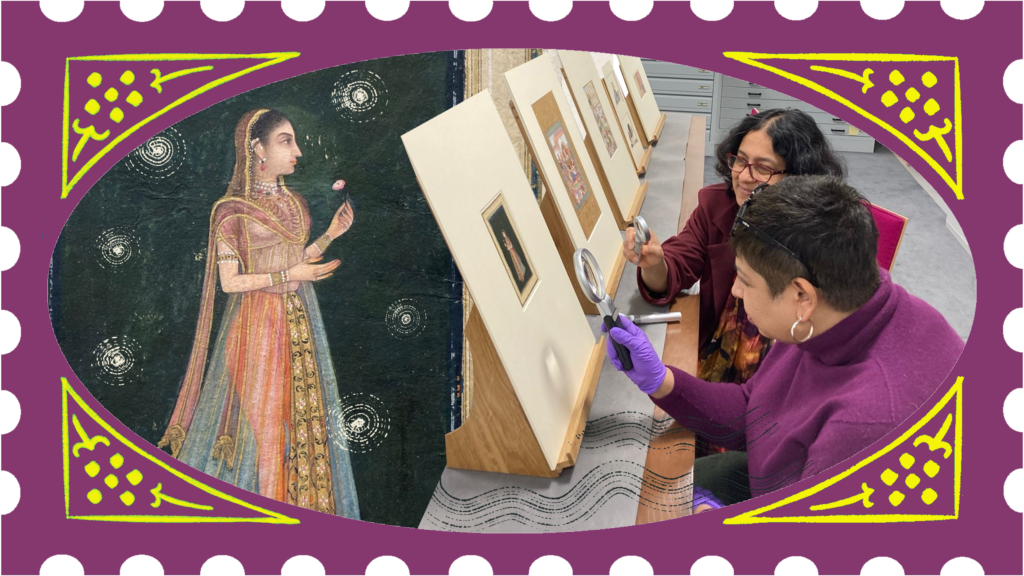
We were handed a pair of gloves and two magnifying glasses as we entered. On a table no longer than two feet, easels held paintings on one side, while material objects lay carefully arranged on the other. We began with the Mughal era paintings.
Nandini, who is a brilliant historian and an even better storyteller — one who has the ability to make characters from Mughal India sound like members of your neighbourhood. She began with Amir Ali, a master calligrapher from Isfahan, whose work travelled to Mughal India and was used to embellish court paintings. We sat in front of a Mughal miniature of a woman dressed in an exquisite costume, examining the folds of the fabric, the jewellery, the posture and the ideal of a Mughal woman imagined by the painters. At some point, we found ourselves linking the garment to Madhuri Dixit’s costume in Dil To Pagal Hai. Forty-five minutes passed and we needed to move on.
Next came court scenes. We leaned in like a pair of detectives, scrutinising every detail—gestures, spatial arrangements, the play of power and intimacy—and piecing together the history embedded in pigment and line. All history writing, after all, is a kind of sleuthing: from oral memory to written archives, from paintings to shards of clay.
And then we came to the final object. It was no bigger than a tiny mosaic tile.
“Guess what this is,” Nandini asked.
“A Harappan seal, hahaha?” I said, half expecting to be rebuked.
“Yes,” she replied. “I saved the best for last.”
My jaw dropped. In my gloved hand lay time itself—the trace of an entire civilisation. It felt like a communion with ancestors of the subcontinent. In that moment, I wasn’t thinking about chronology or historiography or theory. I was thinking about what it means to hold the past between two fingers. An entire civilisation, compressed into something so small, so silent and yet so utterly alive.
Bhanupriya Rao